
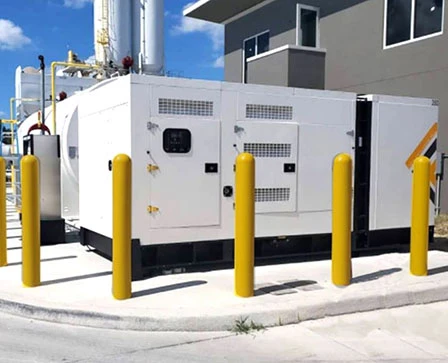
Most data center backup generators run 48 to 72 hours without refueling at normal load. Many facilities are built to run up to 96 hours before they need a fuel delivery. Fuel tank size and facility design decide how long a generator runs. A site with a large tank and an efficient load can run much longer than a site with a small tank and a heavy load.
At General Power, we help data centers plan backup power that keeps critical operations running. In this article, we cover why 2 to 3 days of fuel is the common planning target, how runtime changes by facility type, and what affects your generator’s runtime. We also explain the maintenance limits that apply during long outages and how UPS batteries and generators work together.
Key Takeaways
- Most data center backup generators run 48 to 72 hours without refueling at normal load, and some sites are built for 96 hours or more.
- Fuel tank size is the main limit on runtime, and higher facility load burns fuel much faster.
- Belly tanks typically last 8 to 24 hours, while bi-fuel systems connected to a gas pipeline can run 15 to 20 days or longer.
- Standby generators need servicing after about 500 hours, so long outages require planned maintenance windows and redundant units.
- UPS batteries carry the load for the few seconds to minutes generators need to start before the transfer switch hands power over to them.
- General Power helps data centers match generator size, fuel setup, and runtime to the amount of risk they can accept.
Why We Recommend Planning for 2 to 3 Days of On-Site Fuel
A data center cannot afford to go dark. Even a short outage can mean lost data, broken service agreements, and unhappy customers. That is why we push for enough on-site fuel to cover the first few days of an emergency.
Two to three days of fuel gives a facility room to handle almost any short or medium outage on its own. It also gives operators time to arrange fuel deliveries without making rushed decisions under pressure.
The Mission-Critical Standard
“Mission-critical” means the systems in a data center have to stay online no matter what. Banks, hospitals, cloud providers, and phone networks depend on these facilities every second of the day. If power fails and the backup fails too, the damage spreads far beyond one building.
Across the industry, we see 48 to 72 hours as the usual planning target for on-site fuel. Industry tier standards set a minimum of 12 hours of on-site fuel for higher-tier sites, but most operators we work with go well beyond that floor. This target fits into larger uptime goals because it covers the most common outage lengths while keeping backup power budgets reasonable.
Buying Time for Fuel Deliveries During Widespread Outages
When a hurricane or grid failure hits a whole region, everyone needs fuel at once. Hospitals, water plants, emergency services, and other data centers all call the same suppliers. Fuel trucks can get stuck behind flooded roads, fallen trees, or closed highways.
During these events, emergency services often get fuel first. A data center may have to wait its turn even with a supply contract in place. On-site fuel acts as a buffer during that wait. The larger the buffer, the less a facility depends on trucks showing up on time.
How Runtime Varies by Facility Type and Fuel Setup
No two data centers have the same backup power setup. A small edge site and a large hyperscale campus face very different risks and budgets. Their fuel systems reflect those differences. The table below shows the common setups we work with, how long each typically runs, and where each fits best.
|
Setup Type |
Typical Runtime |
Best-Fit Use Case |
|
Base or belly tank |
8 to 24 hours |
Smaller or lower-tier sites with reliable fuel delivery |
|
Standard mission-critical storage |
48 to 72 hours |
Most enterprise and colocation data centers |
|
Extended-capacity storage |
96 hours or more |
High-resilience or remote facilities |
|
Bi-fuel with pipeline gas |
15 to 20+ days |
Sites with a reliable natural gas connection that need long runtime |
Smaller Base or Belly Tanks: 8 to 24 Hours
A base tank, also called a belly tank, sits directly under the generator. The generator is mounted on top of it, so the tank and generator form one unit. This design saves space and makes installation simpler.
Lower-tier sites often start in the 8 to 24 hour range because these tanks are limited in size. These sites need outside fuel support during longer outages. That support usually means a priority fuel delivery contract, a nearby supplier, and sometimes a hookup point so a truck can refill the tank while the generator keeps running.
Extended-Capacity Sites: 96 Hours or More
We often see high-resilience operations size their tanks for 96 hours or more. These are facilities where any downtime has serious costs, such as financial trading platforms or major cloud regions. Remote sites also tend to choose larger tanks because fuel trucks may take a long time to reach them, even on a good day.
The trade-off is cost and space. Bigger tanks take more room, cost more to install, and need more fuel testing and care over time. In return, the facility has much lower supply-chain risk, because it can ride out long outages without waiting on deliveries.
Bi-Fuel and Pipeline-Connected Systems: 15 to 20+ Days
A bi-fuel generator starts on diesel and then blends in natural gas once it is running. The generator can replace a large share of its diesel with natural gas. This makes the stored diesel last much longer.
When natural gas comes from a utility pipeline, the facility no longer relies only on fuel stored on site. The diesel burns slowly, and the gas supply keeps flowing. That is why these systems can run for weeks instead of days, as long as the gas pipeline stays in service.
Factors That Determine How Long Your Generator Will Run
Generator runtime is not a fixed number on a spec sheet. It depends on how much fuel you store, how hard the generator works, and how the whole facility is built.
Understanding these factors helps you set real expectations. It also helps you find the weak spots in your backup plan before an outage finds them for you.
Fuel Tank Size
Tank capacity is the main limit on runtime. A generator can only run as long as it has fuel, and diesel consumption adds up quickly during an outage. Once the tank runs dry, the generator stops, no matter how well it was built.
We match tank sizing to each facility’s resilience goals. We start by asking how long the site needs to run on its own and how reliable local fuel delivery is. From there, we size the tank to cover that time with a safety margin built in.
Facility Load
Runtime estimates usually assume “normal load,” which means the generator is working at a typical level, not at its maximum. A generator running at half of its rated output burns far less fuel than one running at full output. If the real load is higher than planned, the runtime estimate will be wrong.
The table below shows approximate fuel use for a 2 MW diesel generator with an 8,000-gallon tank. Actual numbers vary by manufacturer and model.
|
Load Level |
Approximate Fuel Use |
Approximate Runtime |
|
50% load |
76 gallons per hour |
About 105 hours |
|
75% load |
108 gallons per hour |
About 74 hours |
|
100% load |
144 gallons per hour |
About 56 hours |
Overall Facility Design
Design choices can extend or limit how long a facility runs. Redundant, properly sized generators can share the load so each one burns fuel more slowly. Fuel type, tank layout, and connections to outside fuel sources all play a role too.
This is why two data centers with similar generators can have very different runtimes. One may have shared fuel storage, a pipeline connection, and spare units. The other may rely on a single belly tank under each generator. On paper they look alike, but in a long outage they perform very differently.
Runtime Limits Beyond Fuel: Maintenance During Long Outages
Fuel is not the only thing that can stop a generator. Engines need care, and that care does not stop during an emergency.
A long outage puts heavy wear on equipment that usually only runs during tests. Planning for maintenance is just as important as planning for fuel.
The ~500-Hour Maintenance Threshold
Commercial standby units generally run about 500 hours before they need servicing. That is roughly 20 days of nonstop running. During long events, operators need to keep an eye on several items:
- Oil checks
- Coolant checks
- Fuel filter checks
- Scheduled maintenance intervals
These checks show why fuel is not the only limit during a long outage. A generator with a full tank can still fail if its oil breaks down or its coolant runs low. Ignoring these items can turn a power outage into an equipment failure.
Planning for Maintenance in Long Outages
We build service windows into long-duration backup plans. That means deciding ahead of time when each unit will be checked, who will do the work, and what parts need to be on hand. Sites that keep up with proper generator maintenance all year handle these windows with fewer delays and mistakes.
Redundant generators make this possible. When a facility has more generators than it needs, one unit can be shut down for service while the others carry the load. This keeps the data center online even while maintenance is underway.
How UPS Batteries and Generators Work Together
Generators do not start instantly. It takes several seconds for a generator to start, reach full speed, and take on the load. A data center cannot go without power for even that short gap.
That is where the UPS, or uninterruptible power supply, comes in. The UPS and generators work as a team, with each one handling a different stage of an outage.
The First Seconds to Minutes
The UPS carries the load the instant utility power fails. Its batteries supply power so smoothly that servers never notice the switch. This keeps equipment running while the generators get ready.
Batteries are a short-term bridge, not a long-term power source. Most UPS systems are sized to run for a few minutes, which is enough time for the generators to start. Building a battery system large enough to run a data center for days would cost far too much and take up too much space.
Handing Off to the Generators
When utility power fails, every part of the backup system has a job to do. Each step happens in a set order, and the whole process takes only seconds. Here is how the handoff works from start to finish:
- Utility power fails.
- The UPS picks up the load right away.
- The generators start and reach full speed.
- The automatic transfer switch moves the load from the UPS to the generators.
This layered approach prevents downtime because each system covers the other’s weakness. The UPS bridges the gap while generators start, and the generators handle the long hours. Together, they keep power flowing from the first second until utility service returns.
Get Your Data Center Generator Setup Right With General Power
Getting backup power right takes more than buying a generator and filling the tank. Your generator, fuel system, transfer switch, and parts all have to work together when it counts. General Power has helped customers in more than 100 countries build backup power systems they can trust. Here is what sets our team apart:
- Every one of our technicians and engineers is EGSA certified.
- We bring more than 20 years of combined industry experience.
- We offer custom generators built to your specs, plus fuel tanks.
- We stock generators and parts in distribution centers across six countries.
From planning your fuel storage to sourcing the right parts, we help you build a system that fits your data center’s real needs. Our team works with you to match generator size, fuel setup, and runtime to the amount of risk you can accept. When an outage hits, you will be glad the job was done right the first time. Contact General Power today to talk with a certified expert about your data center generator setup.
Understanding How Long Can Data Center Backup Generators Run Without Refueling
How long your data center backup generators last without refueling depends on tank size, fuel setup, facility load, and maintenance planning, and the right answer for your facility comes down to how much risk you can accept and how long you need to stay online on your own.
A small site with reliable fuel delivery may be fine with a day of storage, while a remote or high-resilience operation may need four days or a bi-fuel system that runs for weeks. General Power is your partner for data center generators, fuel system planning, and long-term reliability, and we can help you customize a backup system that fits your real needs.
Ready to strengthen your backup plan? Contact the General Power team today to talk through your data center’s backup generator needs, and we will help you build a fuel and power system that keeps you running.